
The dial hiding inside your AI Your AI has a thinking dial. Most writers never touch it.
Most authors who use AI never touch it

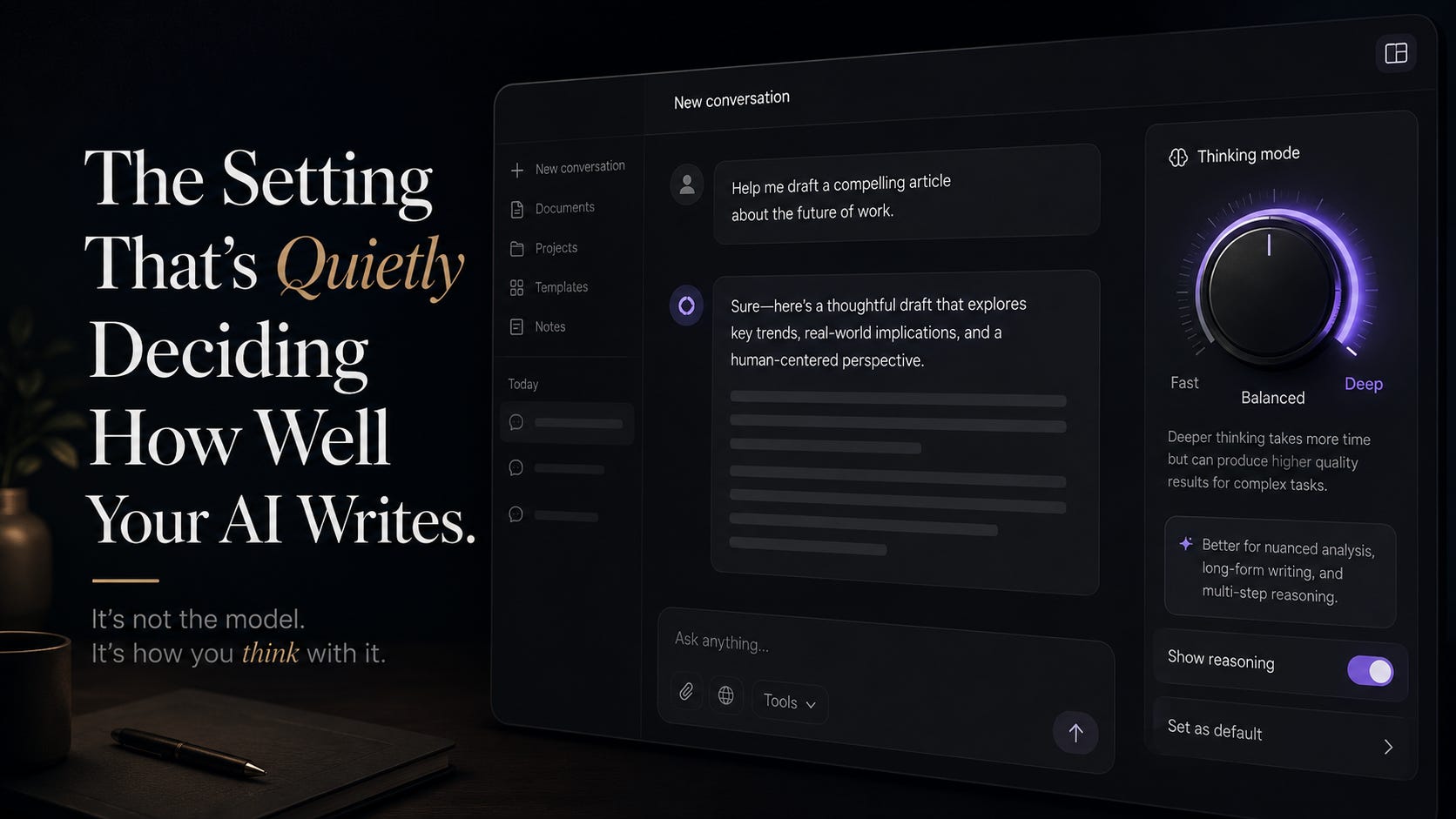
Most writers I talk to treat their AI like a light switch. It’s on or it’s off. You prompt, it answers, and whatever comes back is “what the AI can do.”
But almost every major AI model now ships with something closer to a dial than a switch: a setting that controls how long the model reasons before it writes a single word. ChatGPT calls them thinking levels. Claude calls it extended thinking. Gemini has its own version. The names differ, but the idea is identical. You are choosing how much silent work happens before the first sentence appears.
And here is the dirty little secret: the default position on that dial is chosen for speed and server cost, not for the quality of your prose.
What the dial actually changes
More thinking time does not make the model “smarter.” It gives the same brain more room to plan. With a low setting, the model essentially improvises: it commits to the first decent sentence and builds forward. With a high setting, it drafts internally, weighs structure, considers what the scene needs to accomplish, and then writes.
For a grocery list, that difference is nothing. For fiction, it’s the difference between a scene that wanders and a scene where every detail is doing double duty.
The tradeoff is real, though. Higher settings are slower, and on some platforms they burn through usage limits faster. The dial is not “always max it.” The dial is “match the setting to the job.”
When authors should turn it down
Low thinking settings are genuinely better for some work. Brainstorming wants speed and volume, not deliberation. Quick lookups, name generation, “give me ten ways this scene could open,” rapid back-and-forth while you think out loud: all of that benefits from an AI that answers instantly. Deliberation would just slow the conversation you’re having with yourself.
When authors should turn it up
Turn the dial up when the task has structure to hold: drafting a full scene, revising for a specific effect, untangling a plot problem, checking a chapter against your outline, or any prompt with several constraints the model has to satisfy at once. Constraint-heavy prompts are where thinking time earns its keep, because the model needs room to notice all your rules before it starts writing, not after.
A simple rule of thumb: if you would want to outline before writing it yourself, raise the dial. If you would just start typing, don’t bother.
The uncomfortable part
More thinking usually buys better prose. Usually. Not every level on every platform earns its position, and the differences between adjacent settings can be smaller than the marketing implies. The only way to know what your setting is actually worth is to test it, with the same prompt, at every level, and compare the results side by side.
Which is exactly what I did this week. I ran one fiction prompt through every thinking level in the new ChatGPT and scored every output with the same analyzer. One paid level lost to the free model, and it happens to be the default. Ooops.
The full test, the scores, and the podium are in today’s video (linked below), and the analyzer I used is free this week only, then it comes down. If you want the whole plain-English map of which model, level, and mode fits each part of writing a novel, that’s the new ChatGPT Book Blueprint Bundle (Launch price this week only).
Check out the video: