
Author Math: Why Authors Break Out Between Book 3 and Book 5
$50, then $5,000: What Actually Changed Between Book One and Book Four

In March 2011, Lindsay Buroker made $724 from her two indie novels.
By her fourth book, she was earning a multiple of that. By book ten, she was full-time. Today she has over a hundred titles in her catalog and the income to match. She published her exact March 2011 royalty number on her own blog the following year — $724 — and it became one of the most-referenced data points in indie publishing.
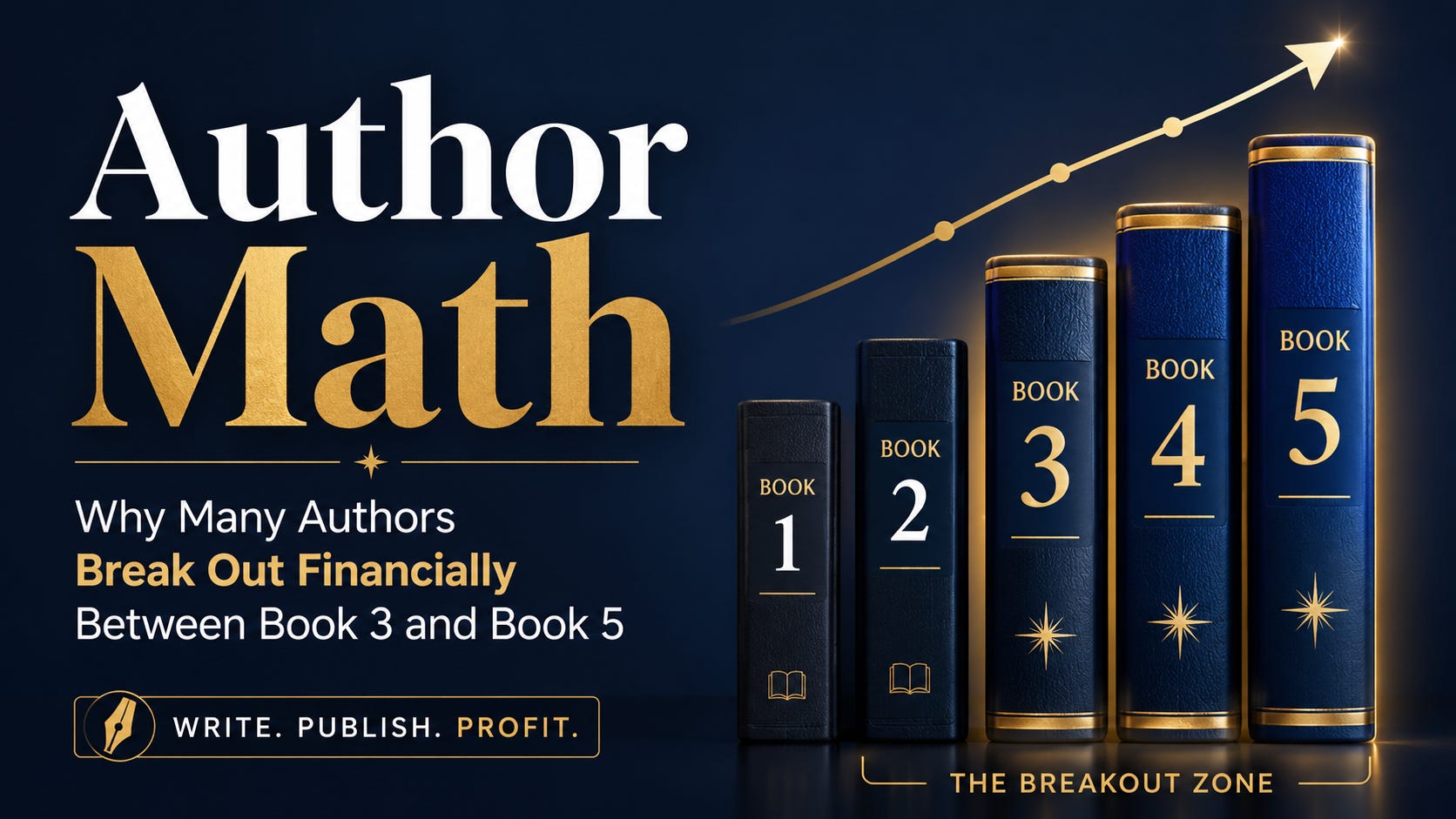
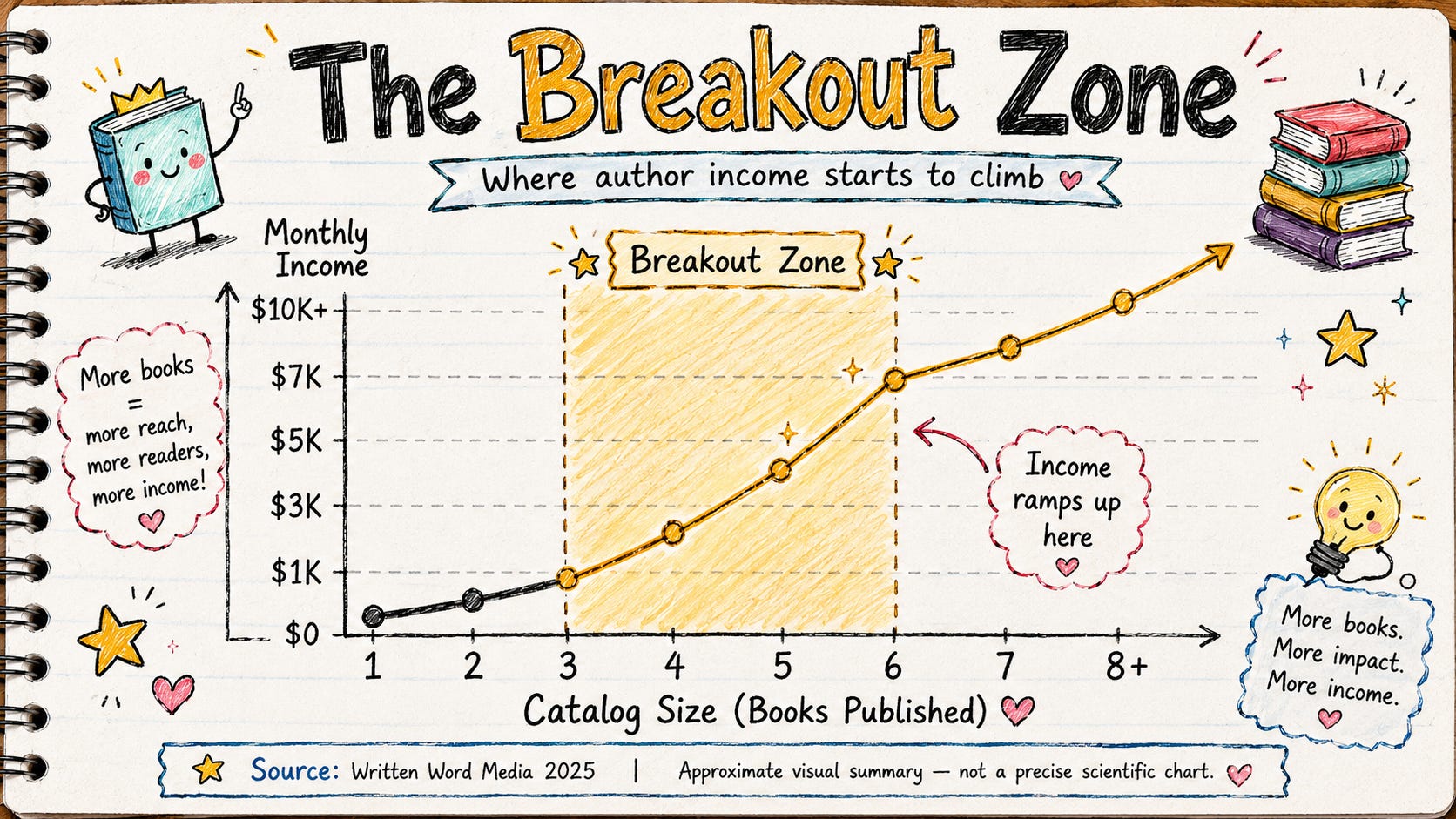
That gap between book two and book five is where indie author income actually changes shape. Not because the writing gets better. Because the math does.
The number that should change how you publish
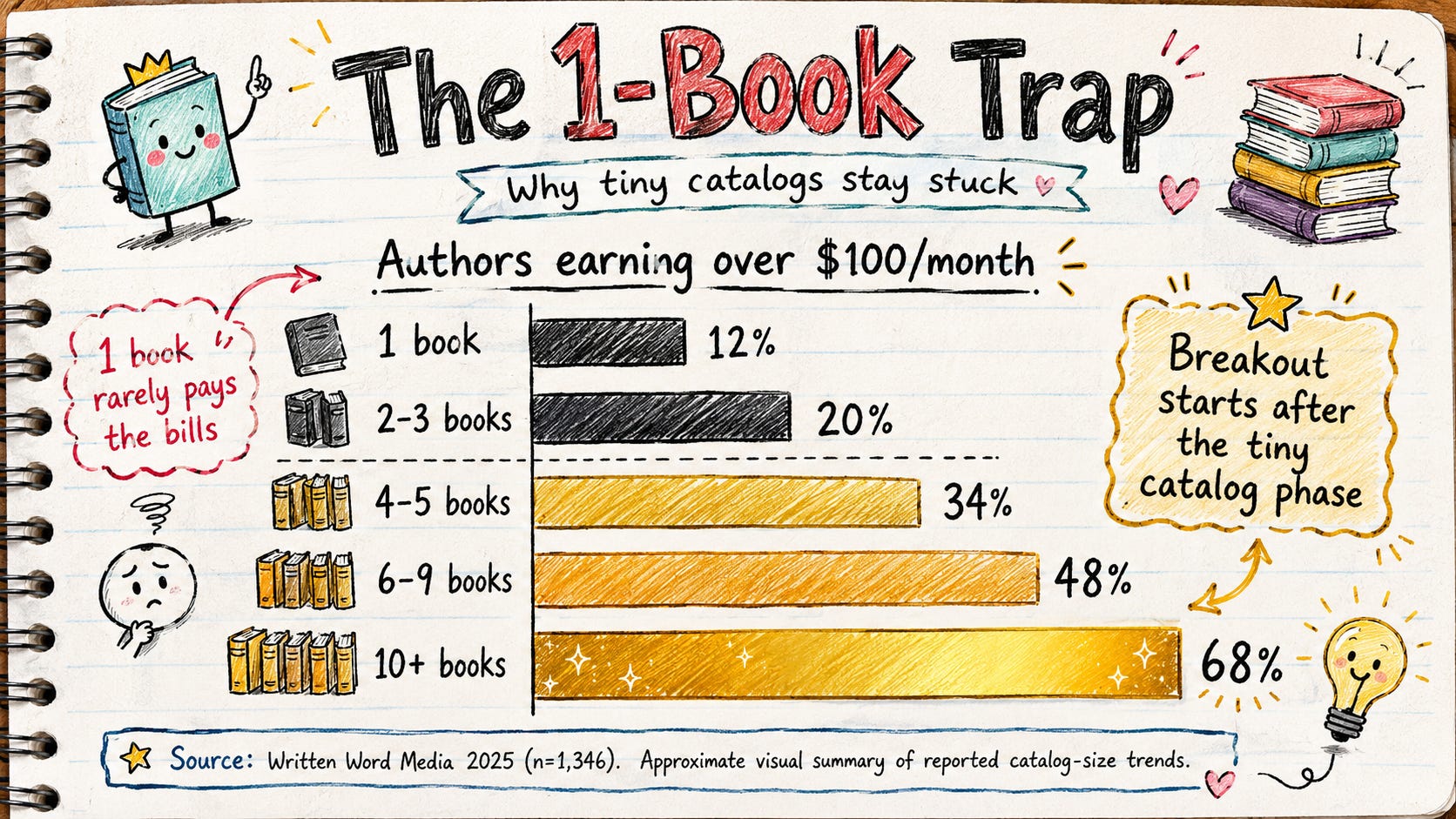
About 80% of indie authors with one to three books earn less than $100 per month from their writing.
Among authors with twenty-five or more books, the median is $3,000 per month — with 40% earning over $5,000.
Both numbers come from the same survey. Written Word Media polled 1,346 indie authors in their 2025 survey. The difference between bottom and top isn’t talent. It’s catalog size.
The income distribution isn’t normal. It’s not close to normal. A few authors earn six and seven figures. Most earn lunch money. The variable that separates them, more than genre or platform or marketing budget, is whether they kept publishing past the third book.
Written Word Media’s 2023 survey put numbers on it more precisely. Authors earning $0 to $249 per month had a median of five published books. Authors earning $5,000 to $7,500 per month had a median of thirty.
Five books get you the bottom bracket. Thirty books gets you a livable income.
Why the inflection point is between books three and five
Three things change once an indie author crosses into the four-to-five book range, and each one is mechanical.
The launch window stacks. Amazon’s algorithm boosts new releases for roughly thirty days. If you have one book, you have one window. If you have four books and you launch the fifth, that launch pulls readers into the previous four titles. Each new release becomes free marketing for the entire backlist.
Read-through becomes a metric. The percentage of readers who finish book one and start book two becomes the actual profitability number. A 50% read-through rate on a five-book series means each new reader is worth roughly three full-priced books in long-term revenue. You can’t measure read-through at one book. You can barely measure it at three.
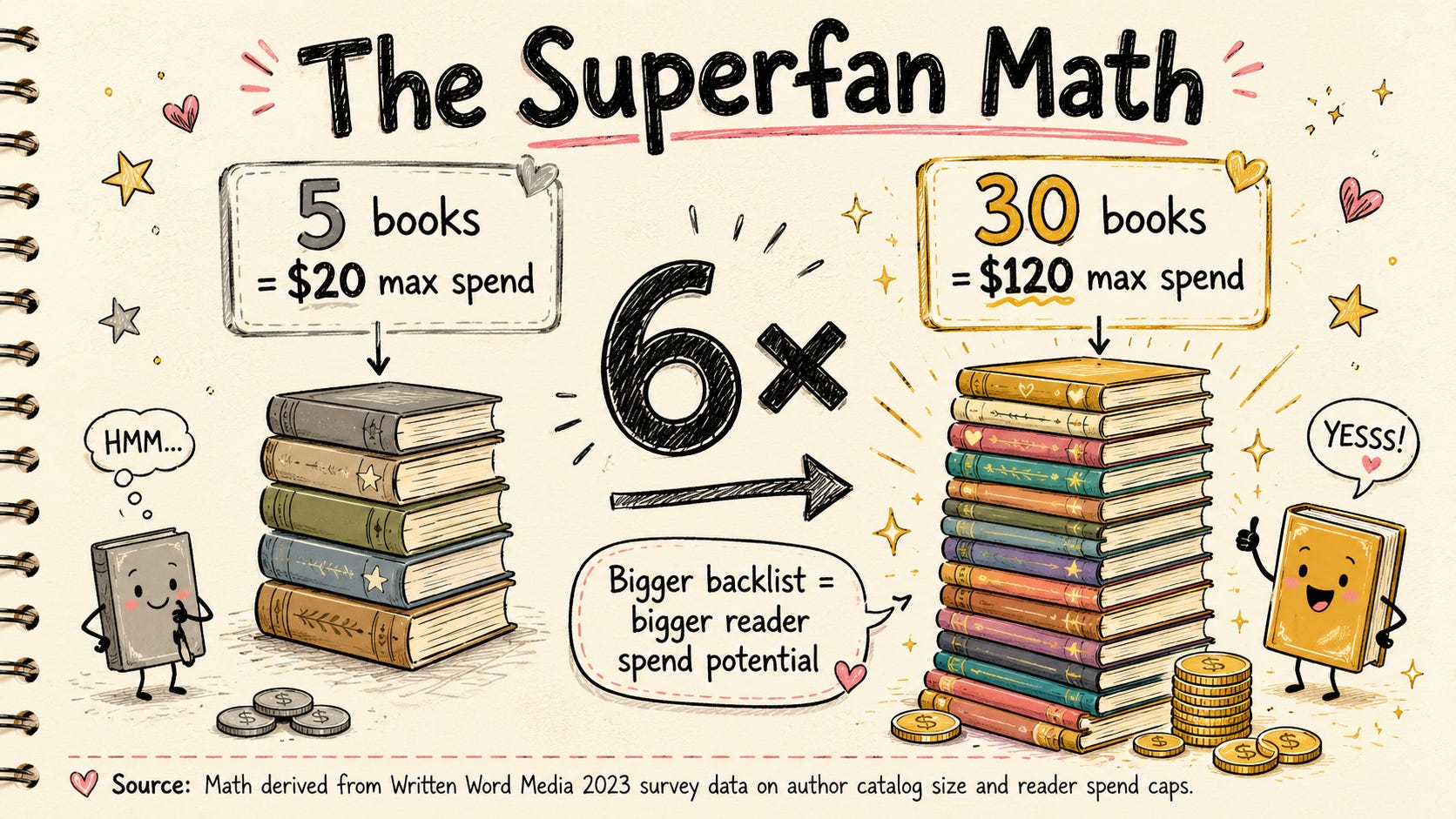
The superfan math kicks in. A reader who loves your work and has only one book to buy from you can spend $4. The same reader with thirty books to choose from can spend $120. Same fan, same enthusiasm, thirty times the lifetime value.
Across multiple years of indie surveys, the strongest predictor of author income isn’t genre. Isn’t quality. Isn’t ad spend. It’s catalog size. Written Word Media calls catalog size “the strongest predictor” in their 2025 report. Draft2Digital reports that 75% of all indie book sales — fiction and nonfiction — are part of a series, by both unit and dollar volume.
The market is structured to reward catalogs. Authors with one book are pricing themselves into a market designed for authors with five.
Real authors, real arcs
The case studies follow the same pattern, just at different speeds.
Lindsay Buroker, as mentioned: $724 in March 2011 with two novels out. By her fourth book, multiples of that. Full-time income by year three of publishing. Over a hundred books today.
Michael Anderle is the fastest documented version. He published his first book in November 2015. From his own podcast interview in 2017: month one earned him $430 gross, month three earned him over $12,000 gross, and by July — eight months in — he had cleared $50,000 net. He hit thirty-five titles within two years. Anderle is the outlier, but he’s an outlier in speed, not in pattern. He ran the catalog play at a faster cadence than almost anyone else.
Mark Dawson, who runs Self Publishing Formula, reportedly earns around $450,000 a year from his thriller catalog. He discusses his income in less specific terms publicly, but the pattern matches — a deep catalog across multiple series (John Milton, Beatrix Rose), built methodically over years, monetized through email lists and read-through.
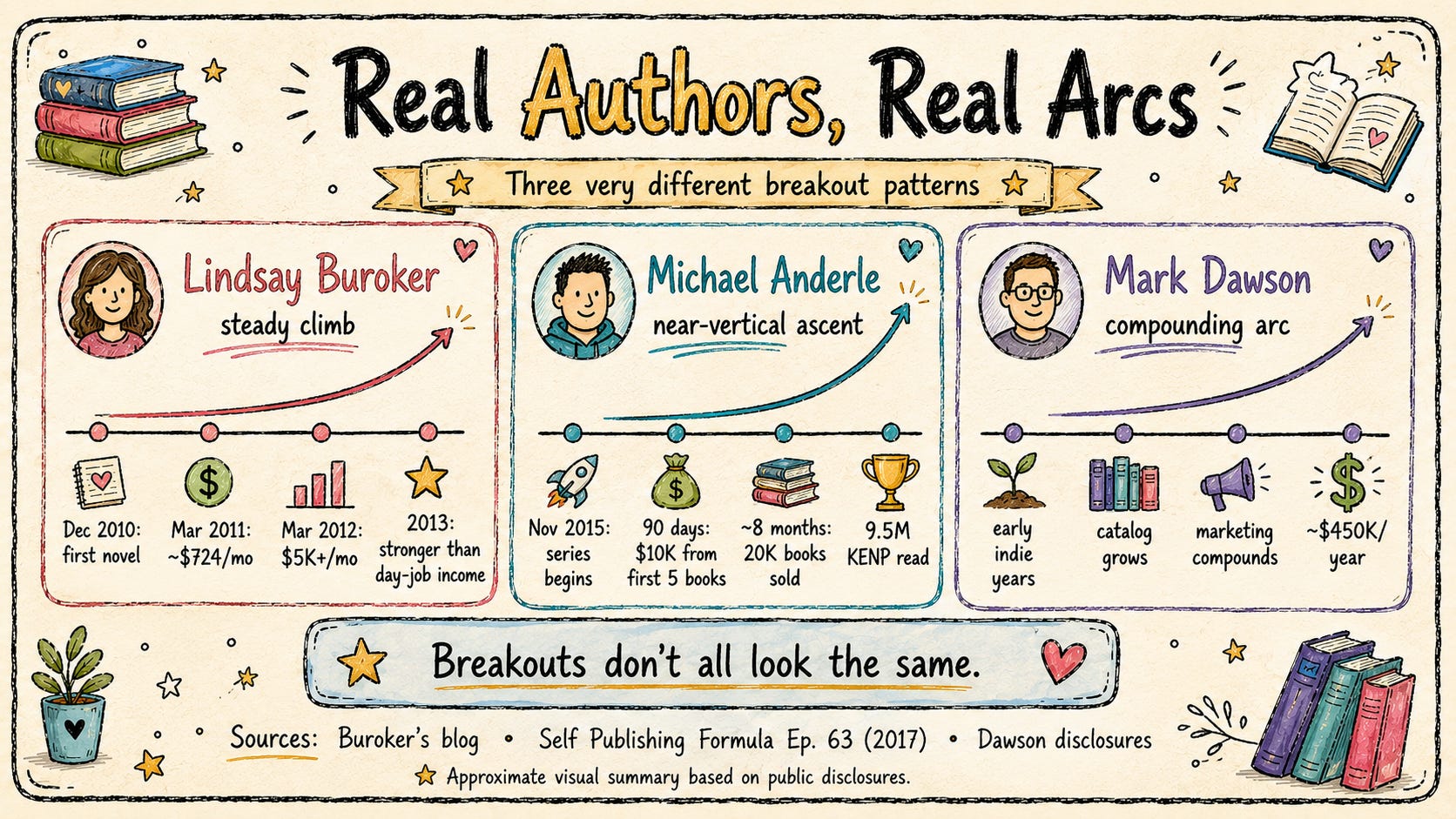
The arc compresses or stretches based on who’s running it. The shape doesn’t change.
The trap that keeps most indies at one book
Most indies stop publishing before they reach the breakout zone.
Not because they want to. Because book one is the hardest one. You absorb every painful lesson: cover design, formatting, blurb writing, launch logistics, reader psychology. By the time you’re done, you’re tired. The financial feedback is also discouraging: nine months of work, lunch money in return.
The rational response is to quit.
But the rational response is wrong. Because one book is the worst position on the curve. You’ve absorbed all the learning costs and captured none of the catalog returns. Quitting at one book is statistically equivalent to lottery odds. Pushing through to five changes the distribution you’re playing inside.
The authors who break out aren’t the ones who got better at writing between book two and book five. They’re the ones who kept publishing while the numbers said it wasn’t working yet.
What to do with this
Three things follow from this data.
Stop optimizing your first book for revenue. It can’t, statistically. Optimize it for read-through instead. Leave room for a sequel. End on a question worth answering. Build an email list aggressively from day one. Your first book is a customer acquisition asset, not a revenue asset.
Track read-through, not book-by-book sales. Read-through is the actual profitability metric. It tells you whether your catalog is set up to compound or whether each book stands alone.
Plan your next three releases before you publish your first. Not the full manuscripts — just the titles, the audience tiers, and the order. A series planned in advance reads as one coherent arc. A series built reactively reads like three unrelated books with the same byline.
This is what indie publishing actually looks like at the income level most aspiring writers imagine when they think about quitting their day job. The math is brutal at one book. It starts working (even in the background) at five. It compounds at thirty.
A note on the data sources
Most of the numbers above come from Written Word Media’s annual indie author surveys (2023 and 2025, with 1,346 responses in the most recent), the Alliance of Independent Authors 2025 income survey (n=1,520 qualifying respondents), and Draft2Digital’s series sales data. Selection bias matters — these surveys mostly reach committed, marketing-active indies, which means the true indie author income distribution is probably worse than these numbers suggest. The US Authors Guild 2023 survey, which captured a broader 5,699-author sample, put the median book income at just $2,000 per year. The catalog effect holds in both data sets. The starting baseline is just lower than the committed-indie numbers indicate.
Disclaimer: Obviously, the math isn’t guaranteed for every author who writes three or more books. That’s simply not the case. However, there is a pattern here worth noticing and a system worth following.
A note on something I just tested
I spent last week running an experiment to see if AI could produce a series teaching this exact lesson — a three-book indie author income series, written by an agent swarm under tight constraints.
Forty AI agents. One prompt. Six hours. Three books on this topic, with real case studies, real numbers, and the catalog math at the core.
I made a video walking through the full demo on YouTube — the kind of swarm architecture I used, where it broke, where it surprised me, what it produced.
If you want to read the three books the swarm actually produced, they’re on my Ko-fi page (Learn more here). Each one includes a transparency note explaining the AI-experiment context up front. The case studies are verified; the prose is the experiment.
The math in this newsletter is real either way. Whether you read the books or not, the catalog effect doesn’t care.
Cheers,
— Christopher
I pretty much agree with all this. It's true. However, I'd add a note of warning. To a large degree, even for established full-time authors, you're also only as good as your last series. And your last series is only as good as its book one. It's this that creates visibility to your backlist. And without it, sales dry up.